
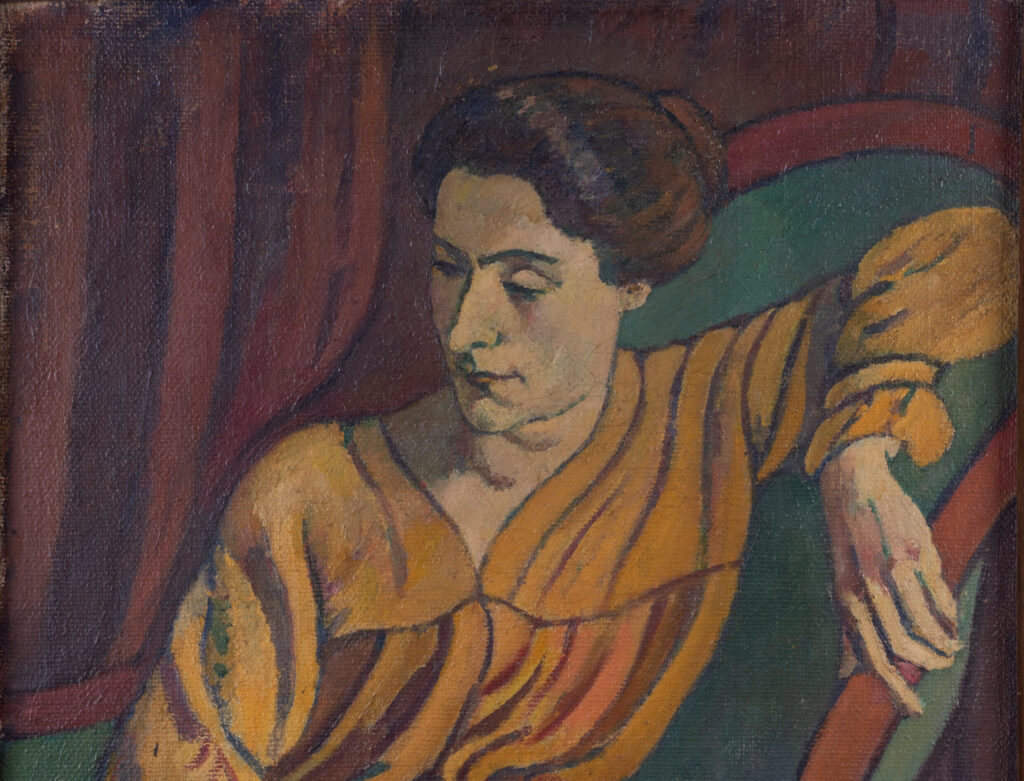
Piero Marussig was born in 1876 into a wealthy merchant family in romantic and literary Trieste at the turn of the century, a cultural and economic crossroads in Central Europe. Between 1899 and 1901 he travelled around Europe, staying in Vienna and attending the Academy of Fine Arts in Munich in the spring of 1901. He joined the Secession and came into contact with the most representative painters of the movement. At the same time, however, he was attracted to Nabis’ synthetic intimism, a Parisian avant-garde post-Impressionist group that in the 1890s sought purity, two-dimensionality, formal synthesis, suppleness of line and softness of colour in painting. From 1903 to 1905, he settled in Rome. From the summer of that year until 1906 he moved to Paris, where he spent time with Henry Matisse and explored the art of Cézanne, Van Gogh, Gauguin, Seurat and Denis. He returned to Trieste in 1906 and moved into an old villa, which became the ideal place for open-air painting and a meeting place for relatives and friends.
In 1919, he moved to Milan where he became friends with Margherita Sarfatti and many artists such as Carlo Carrà, Mario Sironi, Achille Funi, Francesco Messina, Leonardo Dudreville and Anselmo Bucci. His painting abandoned Secessionist linearism to become more solid. It acquired a sculptural monumentality that abolished the hierarchy between space, objects and figures through the use of muted colours and flattened volumes. A delicate example comes from Figura di donna dated 1920. It will be featured in the catalogue of Modern Artists and Multiples until 16 March 2022(lot 1, estimated price €3,000 – €5,000). In this work, the artist from Trieste renders the intimate psychology of the female figure through lines and colours that are echoed in the elements around them.
